As the ruddy sun was low in the sky, we made our way in the panoramic lift up to the Mole Antonelliana’s observation deck.
A striking landmark with its easily recognizable spire, the Mole was originally constructed as a synagogue, soon after Italian unification in the 19th century. By the time it was completed, the city had taken over and the spire was topped with a winged genie that bore a star on its head, a symbol of the House of Savoy.
Today the copper genie is displayed within the Mole and another star, visible when you squint quite hard, has taken its place on the spire. The Mole also houses the Museo Nazionale del Cinema, and is said to have the twin distinctions of being both the tallest museum and the tallest unreinforced brick building in the world.
It is also a wonderful vantage point, and I fancied I could see wispy traces of the different Turins that existed throughout the ages.
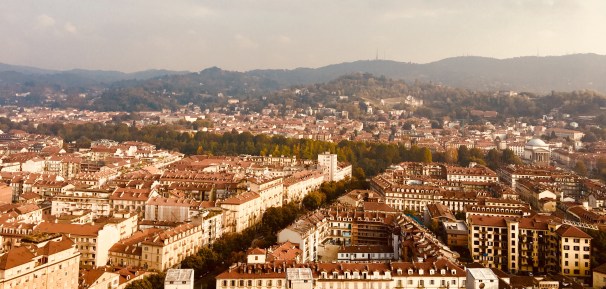
A genie’s-eye view of Turin
First your eye would follow the ghostly echoes of Turin’s beginnings as a Roman garrison (it was called Augusta Taurinorum then) in the grid-like regularity of its square blocks and long, broad tree-lined avenues.
The splendid piazzas drew the gaze next, then the ranks of well-preserved ochre- and sienna-coloured buildings, the city in the full magnificence of the Savoy reign.
You would then notice the seemingly incongruous modern structures here and there, all steel-gray and white and sharp edges, products of Turin’s industrialization and post- Winter Olympics revival.
Finally your eyes would sweep the immutable landscape, the blue-green Po sparkling against masses of foliage in jade and amber and carnelian, and in the distance, the Alps.
It is not the sort of vista to forget in a hurry.
After filling the eyes, one gets to fill the tummy. We descended from the Mole in search of the apericena, that supremely civilized pre-prandial ritual of drinks and nibbles; no stale, half-hearted party after-thoughts these are, too, but properly delicious mouthfuls.
So we returned to the picturesque Piazza Vittorio Veneto,one of the largest squares in Europe. It was a perfectly indolent spot for taking in the sights, with an Aperol spritz in one hand and a constantly-changing plateful of savouries in the other.
We could see straight over the bridge named after Vittorio Emmanuele I spanning the river to the Gran Madre; here, a neighboring cafe filling up with a jolly crowd; over there a large snowy-coated dog (was it a Great Pyrenees?) snuffling hopefully round the chairs. A tram in the city’s blue-and-gold livery rumbled past.
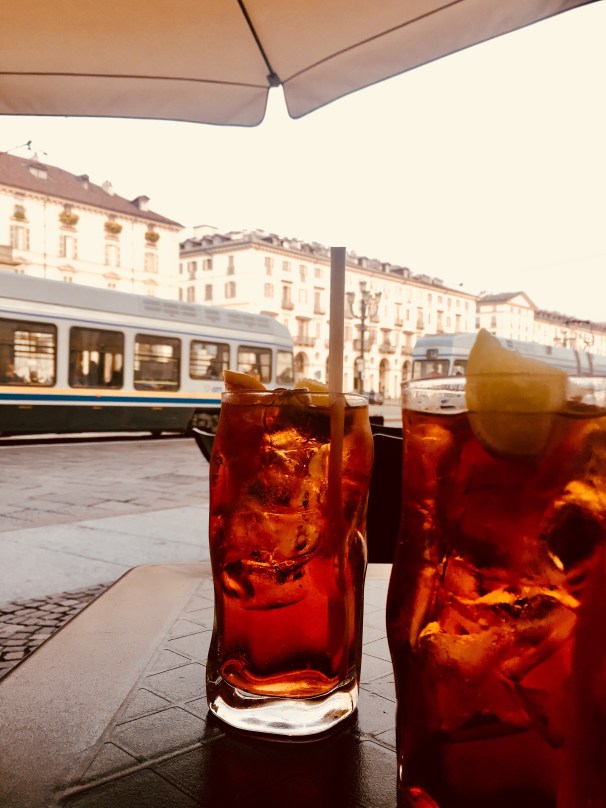
Aperol spritzes on a fine autumn day
And as twilight faded into dusky evening we strolled down to the Po. It was still early in the season for the gaiety of the pop-up restaurants, so the riverbanks were still, illuminated by lamplight.
Joggers and bikers went past, as did a massive canine with the markings of a sheepdog and the size of a young pony. Rowboats glided along a surface a-twinkle with reflected radiance; and yet for all the activity, there was a calm, restrained hush, so remarkable for being in the midst of a major metropolis.
On the drive back home I was seized with a sudden melancholy. I thought back to the reluctant cocker spaniel I had seen earlier along the Via Roma; the obstinate pupper had sat down on its haunches and was being pulled along on its derriere.
That was me, that was how I felt about leaving, and they would have to drag me by the scruff of the neck out of here.
Discover more from Cassandra Cuevas
Subscribe to get the latest posts sent to your email.
