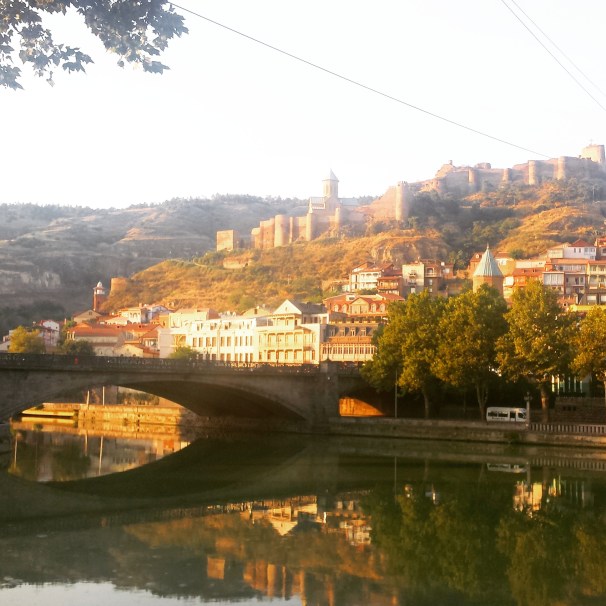
Mornings spent dreaming by the banks of the Kura.
Tbilisi, Day 2.
Woke up refreshed after a good night’s sleep, undoubtedly helped along by that glass of rosé on the terrace the night before.
Dodged traffic at the crossing – Third-World skill set came in handy, hurrah – to get to the banks of the Kura River, a wide and placid green ribbon that stretched unhurriedly into the cool periwinkle distance. Ducks floated serenely on the rippling reflections of state buildings that rose in sweeping angles of grey and ivory.
Walking along it, you would never even think that the picturesque Kura originates in the craggy slopes of the Caucasus, and that it flows through three countries before opening into the Caspian Sea. It looks so mild and unassuming, a mighty voyager masquerading as a provincial backwater.
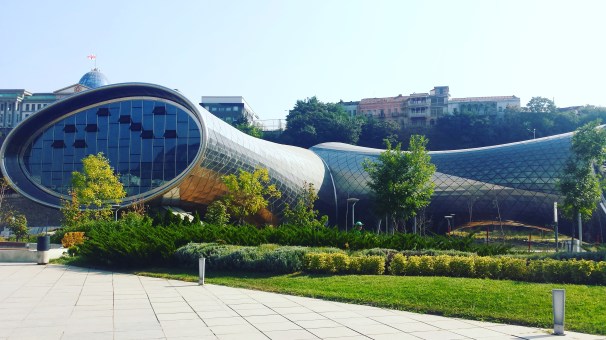
Eventually I got to Rike Park.
Inspired by Georgian hunting horns, this abandoned building actually reminded me more of that Murakami story in which a super frog saves Tokyo from a giant worm. (My mind goes to some quirky places sometimes.)
The pedestrian Peace Bridge was another stunner, a thoroughly contemporary creation stretching across the ancient Kura. Like the hunting horn/giant city-destroying worm building, it jolts you out of your bucolic contemplation.
Pine trees, you think, crisp northern breeze, time-worn turrets on a hill…. oh, look, a glass and steel behemoth that looks as though it crash-landed from some dystopian Soviet version of the future.
Wandering feet (never mind the usually faulty sense of direction) brought me to the Sioni Cathedral, and from there to tourist central with the cheerfully kitschy I Love Tbilisi sign. In case you were worried about this being an unrequited affection, Tbilisi loves you! proclaim the decals on the airport floor.
My hosts had recommended the khinkali at Machakhela, so I commandeered a corner table outside, facing the square and the equestrian statue of King Vakhtang Gorgasali in front of the Metekhi Church, dramatically poised on the rocks above the Kura.
The king is said to have moved the royal seat here after being suitably impressed by the healing properties of the valley’s numerous sulfur springs; tbili is the Georgian word for ‘warm’ and to this day the city’s bathhouses are popular attractions.
Back to my brunch.They say the correct way to eat these dumplings is to slurp out the soup inside first, which I managed to do without making a mess (familiarity with xiao long bao is an advantage), washed down with a bottle of Georgian lemonade (which will figure prominently upon my return to Doha).
Suitably fortified, I endeavored to climb- in my billowing ankle-length skirt with the slits up the sides because I’m practical like that – to the Narikala fortress, which lay like a fairy tale ogre’s hideaway on the hill. This activity is not for the literally faint-hearted or shaky-kneed, and I only did it because the cable car was under repair.
Going down is just as much of an ordeal – lose your footing on the cobblestones and you’re likely to tumble all the way back to the square whose name I still can’t recall.
Stopped to send some postcards (let’s see how long it takes; the one I sent from King’s Landing took three months to reach home) and buy the usual souvenirs before going for a stroll around the historical quarter.
From Freedom Square, through tree-lined sun-dappled old streets, I emerged into ‘new’ Tbilisi: designer boutiques, sleek millennials dressed au courant, shiny office buildings. Crossed underground to pretty Rustaveli Avenue, where book sellers abound and gorgeous architecture pops out from nowhere.
On the other side of the avenue a flower-strewn courtyard beckoned. I stepped through the gates and found myself in a bibliophile’s wonderland.
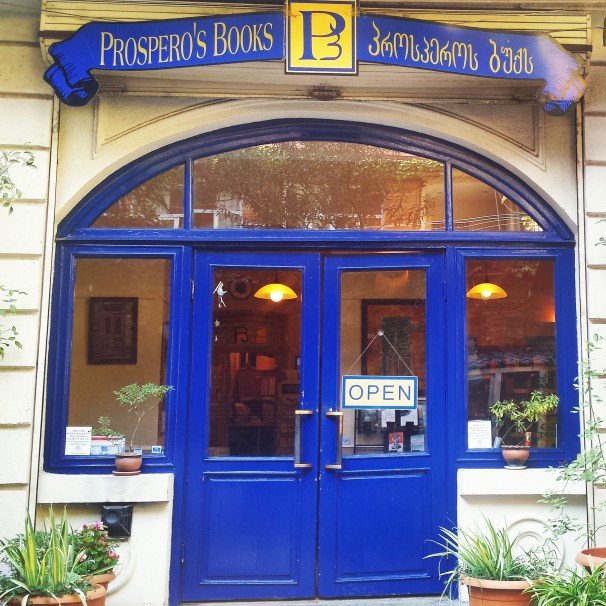
Bookstore and coffeeshop? Yes, please.
And that was where I spent the rest of the afternoon, seated in a patch of sunlight with tea and cake and three new books: The Russia House by John le Carré, a compilation of Georgian stories, and BJ Novak’s One More Thing. I do tend to find excellent reads while on holiday; remember Brandon Sanderson’s Words of Radiance in Dubrovnik?
As the sunlight faded I began the long walk back down Rustaveli – sidetracked for a bit by a park that you enter through high wrought-iron gates, and by then I was thirsty and it was the perfect place to find one of Tbilisi’s many drinking fountains- again, much like Dubrovnik, the water is cold, clean and perfectly potable everywhere.
Gratefully plopped down onto a stone bench to reorient myself and noticed that I was now in Pushkin Square, so of course my thoughts went back to that time we spoke of Russian literature.
…..
Shaking myself out of this reverie, I picked a road leading out of the square, set out in search of dinner and was promptly waylaid by an all-too-Asian craving when I passed by a Korean restaurant. Bibimbap in the Caucasus. The triumph of globalization and capitalism, everyone.
Lost again in the deepening dusk, I just kept on walking and walking and walking, heading back in the direction of the tourist square until I found a cab. Successfully negotiated the usual five-lari fare, and back home, once more settled myself on the terrace with my rosé.
But I was to have company that evening, for the neighbors across the hall had returned from an all-day excursion and were in the mood to share dinner.
They were a gregarious Muscovite couple and soon we were trying to enumerate all fifteen former Soviet republics (we forgot Moldova), conversing about Cossacks and Baikonur and Turgenev and the Bolshoi and Plushenko… aaaand some very interesting KGB family stories.
Felt like I was in a Clancy or le Carré novel then, looking over the city lights of a former Soviet state capital, talking about spies with the Russians. 🙂
Discover more from Cassandra Cuevas
Subscribe to get the latest posts sent to your email.
